Our love of a good story: or why we watch The Great British Bake Off
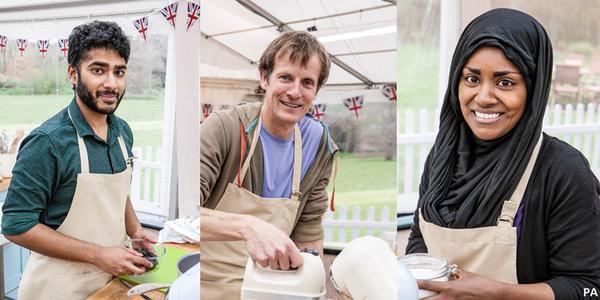
The Great British Bake Off final screens tonight and at least 12 million of us are expected to cluster around our televisions to discover if Nadiya, Tamal or Ian will win.
Countless thousands of words have been written about the continued allure of this programme. I've argued that Bake Off appeals because it conjures up a rural way of life about which we are deeply nostalgic: the world of the village fete, of an England of "long shadows on cricket lawns", as John Major once put it; or Orwell's "old maids bicycling to Holy Communion'. Of warm ginger beer and Downton; fresh scones and buttered crumpets; the promise of "honey still for tea"; the sound of leather on willow.
It's also a world of kindness: bakers are givers, and work in a "spirit of generosity", according to the BBC's Martha Kearney. If a Charlotte Russe starts to fall apart, or the biscuit panels of a chocolate showstopper shift, the bakers will spring into action to help one another - even if Ian's set jaw hints at a determination to win.
Crucially, as I've blogged here, the appeal of the GBBO also lies in teasing out the psychology of the bakers: puzzling why a junior hospital doctor might want to spend his spare time fashioning a cardamom, blackberry and raspberry Charlotte Russe. Or why a photographer to the Dalai Lama is so perfectionist he forges Heath Robinson style gadgets to ensure his bakes are sufficiently precise. Or a mother-of-three, who never usually feels proud of herself but whose inner conviction grows as we watch her, decides to enter the competition in the first place.
But I've also realised that the GBBO fulfils our need for a good story. Plotting my third novel, I've been reading John Yorke's excellent Into the Woods: how Stories Work and How We Tell Them, and thinking about the narrative journey, the conflict and jeopardy a protagonist must go through. Yorke's analysis covers films and TV programmes such as Thelma and Louise, Spooks, and Pulp Fiction - a far cry from the gentle, apparently plot-free world of Bake Off - and yet the idea of a hero facing several feats as s/he battles to fulfil his/her quest of becoming the winner; of him overcoming adversity and undergoing a process of self-realisation applies just as neatly here.
At the risk of over-analysing a programme about bakers in a tent, I believe we love the GBBO because we want to see that hero evolve: we believe the winner should be the contestant who endures the greatest set backs in their journey and who develops the most throughout the ten weeks. The worthy hero is the baker who has undergone the greatest process of self-realisation: having battled their own self-doubt, and undergone their own baking disasters - a wrongly-judged flavour or, better still, a collapsing structure or a timing crisis; something that puts their existence in the competition in real jeopardy - while whipping up exquisite cheesecakes and patisserie.
The rightful winner - according to our need for a good story - and the favourite to win is, of course, Nadiya. Her back story alone marks her out as a worthy hero: the young girl who grew up in a Bangladeshi family where they cooked, but never made desserts. Taught to bake by her school home economics teach, she didn't make star baker until week five and initially struggled with the technicals - failing to complete her vol au vents. But with her creative inventiveness, she has battled through to become star baker three times; while her expressive facial expressions and emotional honesty mean she lets us, the viewers, in on the journey she is experiencing. Ian is just too emotionally cool; Tamal, despite his Eeyorish fear that he would never be star baker, perhaps a little reserved for that.

Of course, on a wider level, the hijab-wearing Nadiya deserves to win, according to the rules of a good story, because she was perhaps the most unexpected contestant. As she told The Radio Times: "Originally, I was a bit nervous that perhaps people would look at me, a Muslim in a headscarf, and wonder if I could bake."
When the first programme aired there was snarling in the Daily Mail about the line-up being "more right-on and politically correct than a Benetton ad", and yet with her humour and, crucially, her skill she has silenced such critics. This weekend, the Telegraph championed her for doing so much to remove prejudices against women wearing the hijab. As Nadiya herself has said: "I hope that week by week people have realised that I can bake - and just because I'm not a stereotypical British person, it doesn't mean that I am not into bunting, cake and tea."
Of course, our need for a good story doesn't mean she will win. Never underestimate a baker, such as Ian, who makes their own gadgets: after all, Nancy, who turned up with a jaffa cake guillotine in week one, triumphed last year. And Mary Berry has done much eye-twinkling and winking at both Ian and the series' beauty, the equally impressive Tamal.
But, worthy winners though they may be, there will be a collective groan at 8.58 tonight if Nadiya doesn't claim the Bake Off crown. Her inventiveness means she deserves it - but this isn't about the bakes; it's about her undergoing a quest and experiencing a hero's journey.
It's the ending that the story of this year's Bake Off deserves.
Why we bake: patisserie.

Compared to many of my fellow novelists, the research could hardly be described as arduous: making choux pastry and deliberately allowing the mixture to catch. I was trying to describe a baking disaster and had convinced myself the only way to do so was to act it out. The smell of burnt sugar filled my kitchen as the pan’s sides burned, and lumps of egg and cornflour congealed into sweetened scrambled eggs.
As The Great British Bake Off enters its patisserie week, I was reminded of this moment, which came as I finished my novel about why we bake. Despite my mother excelling at that 1970s dinner party staple, profiteroles, and my making a mean crème pat, I had never attempted choux. But writing The Art of Baking Blind, a novel partly inspired by the GBBO, taught me to push my culinary boundaries. Forget method acting, this was method writing: immersing myself in a world of melted butter and sugar; of egg whites whisked into stiff peaks, and rising dough. Cocooning myself in the scent of warmed cinnamon and nutmeg; learning how to make a patisserie at the heart of my novel - the tarte au citron.
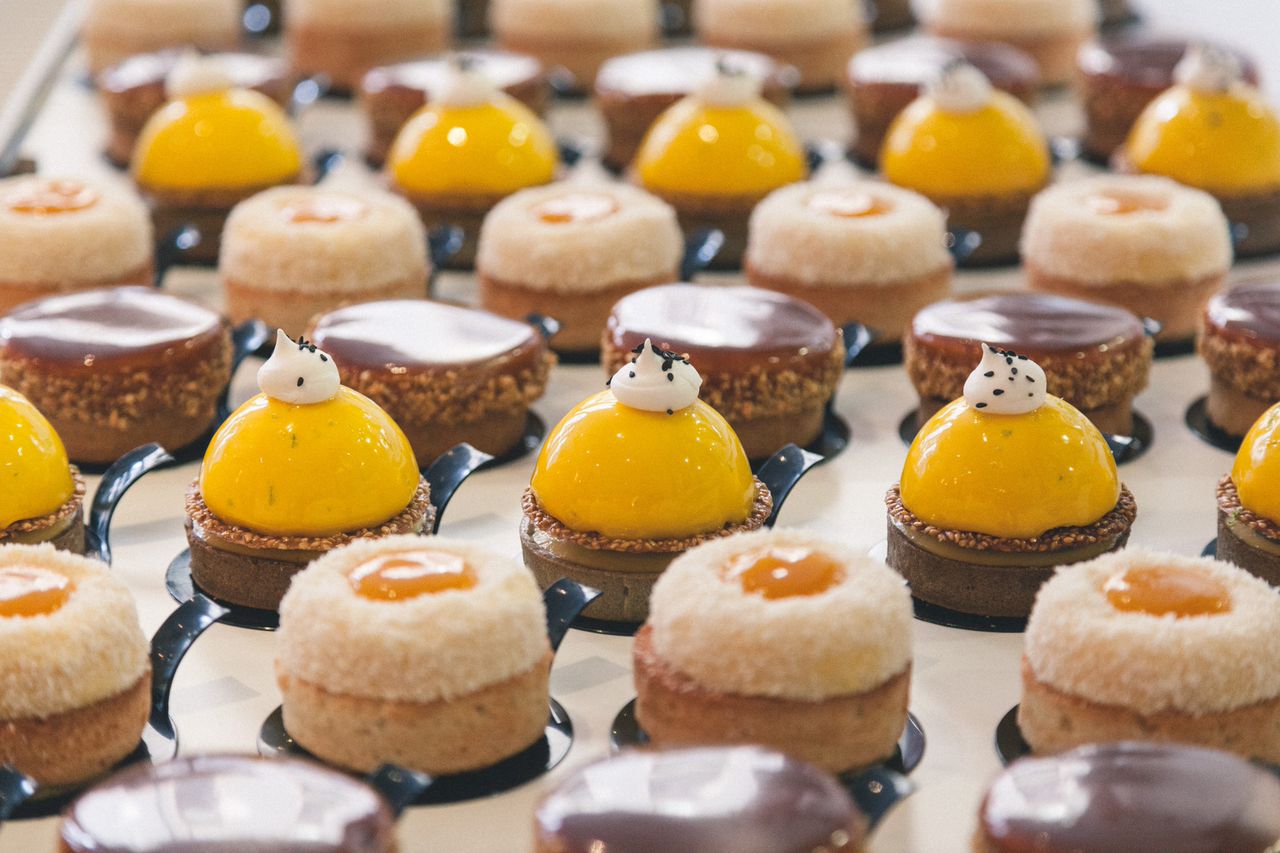
Mango coulis, citron crème pat, ganache, choux, a galette base: patisserie for the launch of the French edition of The Art of Baking Blind, La Meillure d'Entre Nous.
I first came up with writing a novel about why we bake as I made sponges and gingerbread men with my small children. For me, baking was the perfect way of doing something creative while proving that I was a good mum. If that sounds extreme, I’d given up a job as a senior reporter and former political correspondent on the Guardian to freelance and be a stay-at-home mother. Used to writing every day, I wanted to mix and churn, to beat and whisk, and crucially to come up with something delicious at the end of it. Because that way I was not only achieving something but I was showing my children – with my roast chickens and homemade stocks, soups and risottos as well as my cakes and biscuits – just how much I loved them.
I realised I was over-investing my baking with emotion when I took a tin of homemade chocolate chip cookies, made with my four-year-old, to some new friends on a play date. “Talk about showing us up!” laughed another mother, her tone distinctly brittle. “Can’t you just bring a packet of jammy dodgers like everyone else?”
I began to think about why I bake and what motivated other bakers I knew: the mums decorating exquisite cupcakes for the school fair; the stick-thin mother who had heaped my plate with birthday cake as a child; the contestants who put themselves through competitions like GBBO, who were willing to spend hours spinning sugar or constructing gingerbread houses they knew would immediately be demolished. Because I was sure that our obsession with baking wasn’t just about nostalgia in a time of recession – though that may be part of it - but about the fact that we can we can work through all sorts of emotions while we create with eggs, fat, sugar and flour.

Profiteroles sold in Le Marais, Paris; filled with rose water or chocolate crème pat and sometimes gilded with gold leaf.
With this in mind, I used the characters in my novel to illustrate different reasons we bake. For Jenny, a housewife and mother whose daughters have flown the nest, it remains a way to prove she loves her family, even if they no longer need her. But it’s also a habit, a means of working through her emotions, and a way of connecting with a happier past.
For Vicki, who remembers her childhood kitchen as “a cold room…in which she ate supermarket quiche and watery iceberg,” baking with her son is a means of providing him with the loving childhood she lacked. Constrained by motherhood, the baking competition also allows her to do something creative and to carve out some time for herself.
For Mike, a widowed father, baking not only provides some validation but is therapeutic, while for Kathleen Eaden, the cookery writer whose 1966 cookbook, The Art of Baking, inspires the baking competition and informs the novel, baking is such an extension of her personality that what and when she bakes mirrors her mood and reflects the plot.
And then there is Karen. For if most of the novel’s associations with baking are positive, for her there are more sinister connotations. She doesn’t bake because she is frustrated or needy, like Vicki, but because she is a perfectionist for whom baking is the ultimate means of control.
Launching the French version of The Art of Baking Blind, La Meillure d'Entre Nous, in Paris earlier this year, I kept being reminded of this, my most troubled, character. For patisserie is the form of baking which, more than any other, demands self restraint and an obsessive attention to detail.
I could see this in the patisserie created for the Livre de Poche launch: delicacies involving passion fruit gel on mousse au citron with sesame tuile and black sesame crème pat, or citron crème pat and black sesame shortcrust, topped with a tiny, sesame-dusted meringue. It was evident in the shops specialising in exquisite profiteroles or sables biscuits; confections sandwiched with mango, vanilla, chocolate or citron crème pat, and laid out beneath glass cabinets as if they were expensive jewellery; and even in the blowsy displays of more traditional patissiers: the glossy tarte aux fraises; the rich curls of dark chocolate; the plump religieuses; the dinky macarons and expertly-constructed millefeuille.

I spied these sentiments, too, in the readers who discussed why the bakes in my novel were not as creative - or as accomplished - as those in their patisseries; or who gently pressed me to taste their creations.
One reader had spent the day making 100 macarons in seven different flavours - including blackberry, citron, pistachio, chocolate and raspberry - for a friend's macaron pyramid birthday cake; a feat she pulled off while racing through 100 pages of my book. "You're a good friend," I commented as I bit into her tiny, light-as-air pistachio creation and listened to the coos of other women doing the same; and she shrugged, in self-deprecation. "It was nothing." She had pulled off the ultimate trick: patisserie that was perfect but that claimed to be effortless.
Her answer, though, also conveyed the motive that I think is at the heart of most baking. For while we may bake out of neediness, because we're frustrated, competitive or suffer from what French Elle describes as "the tyranny of slimness", most of us bake "in the spirit of generosity" as the BBC's Martha Kearney, herself the winner of the Comic Relief Bake Off, has said.
Or as Kathleen Eaden declares in my novel: "There are many reasons to bake: to feed, to create, to impress; to nourish; to define ourselves; and sometimes, it has to be said, to perfect. But often we bake to fill a hunger that would be better filled by a simple gesture from a dear one. We bake to love and be loved."

Ladies finger cutters and a fondant gusset: the secret of GBBO's success

It was a question the author and journalist Allison Pearson knew might be seen as "heretical." Has this series of The Great British Bake Off become just a little bit dull?
Had the "perfect soufflé of primetime patisserie run out of puff?" she asked. The contestants bland; any sense of suspense or jeopardy gone. Had it not only deflated this year but never really risen at all?
The Telegraph columnist, posing the question last week, was absolutely right about the lack of suspense. There's been no Bingate this year - the carefully-edited moment in which a Baked Alaska was taken out of a freezer and left to melt by a rival contestant. Ian's reign as star baker was becoming wearing, and, before Wednesday night when the contestants were culled to five, there was not one ounce of jeopardy at all.
And yet for me, and I suspect many of the ten million viewers who still tuned in this week, suspense isn't the reason we watch this primetime success. We view it for the characters as much as any competition or bakes: trying to fathom what motivates them to spend three hours in a tent constructing a Victorian fruit cake decorated as a tennis court.
Why would a prison governor discuss, in all earnestness, and without any sense of irony, the importance of fashioning a bread lion - and not a dog? What leads a gentle male nurse, on the edge of tears, to confess to over ten million people: "My father was a general. Failure is not an option." And why does a young mother-of-three, dispelling stereotypes by baking in a headscarf, and with a superlative array of facial expressions, admit, her voice shaking with relief and a sudden shot of self-belief: "I'm never proud of myself but I'm actually really proud." Moments like these - swift glimpses into the deepest recesses of the contestant's psyches - are the point of Bake Off:

I'm intrigued as to why firefighter Mat, who grew up in a house "where we didn't have dinner parties; don't think my mum ever made a vol au vent" thinks he can wing it in a competition in which he didn't practise for the latter stages, never thinking he'd get there. ("Don't let a fondant tennis court be the end of it," admonished Sue. And yet it was.) Or why bluff prison governor Paul, a man who shrugs off criticism like the proverbial duck in water, wants to fashion a fondant bikini, with gusset, or sculpt an apple into a swan. ("I learned it in a day. It's what I like doing. The arty side of things," he told Mel.)
Then there are the bakers who are so perfectionist they make Heath Robinson style gadgets with which to perfect their creations. Last year it was Nancy, who produced a guillotine to slice her jaffa cakes in the first episode - and went on to win. This year, it's Ian, who bakes bread in a flowerpot, fashions steel to create leaves, and this week produced a ladies finger chopper.
"Each of my ladies fingers is exactly nine centimetres long," he explained, with a somewhat wolfish grin. Coming after his Road Kill pie, inspired by kill that's been "bumped not flattened", this sounded not just exacting but slightly sinister.

Of course, these eccentricities are gentle. Bake Off remains a warm, comforting bath in a troublesome world. An hour of unapologetic escapism in which people are largely nice - although, over half way through, some more overt rivalry is finally, thankfully, coming to the fore.
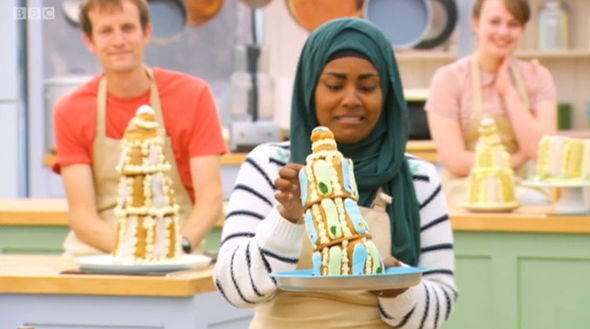
It was there in Nadiya's one-handed clap against her bicep when Ian constructed a show-stopping Victorian crown and her less-than-effusive "very good". (The sort of "very good" you could imagine her giving a child who consistently draws better than its younger siblings - but still wants praise.) It was there in Flora's shake of the head, arms crossed like a curmudgeonly gossip, and her or Nadiya's: "Flipping heck!" (It could have been either of them.) We could see it in Mat's flash of irritation - "Aww, you've twisted it" - when Paul, trying to help him ease his Charlotte Russe onto a pedestal - apparently exacerbated the split. And in Ian's barely-perceptible tic of disappointment - a slight tightening of the jaw - when anaesthetist Tamal, beautiful, and distinctly Eeyorish after daring to hope he might do well and then failing last week, finally became star baker.
Writing in yesterday's Telegraph, last year's winner Nancy revealed that "once you get to half way it's a completely different atmosphere. It becomes more intimate." Much of the set is cleared away and the crew scaled down; contestants know the production team, the judges, and each other.
For the viewers, things become more interesting, too, for we know the remaining, more-focussed, bakers well enough to care. We're attuned to the tensions, as well as to their loyalties - or lack of them. We can predict that Nadiya will look at Mat in utter disbelief when he says he's put his icing tennis rackets in the oven.
"Oven?"
"Yeah."
"Were we supposed to put it in the oven?"
Or that Mat, in those few seconds of horrified disbelief, will know, as we do, that he's going home that week.
In fact, that moment encapsulates the GBBO style of suspense. Momentary and understated but still poignant and telling in its own small way.
It's the quarter final next week. Here's to more of these vignettes.

The Art of Baking Blind: nestling up to Poldark.

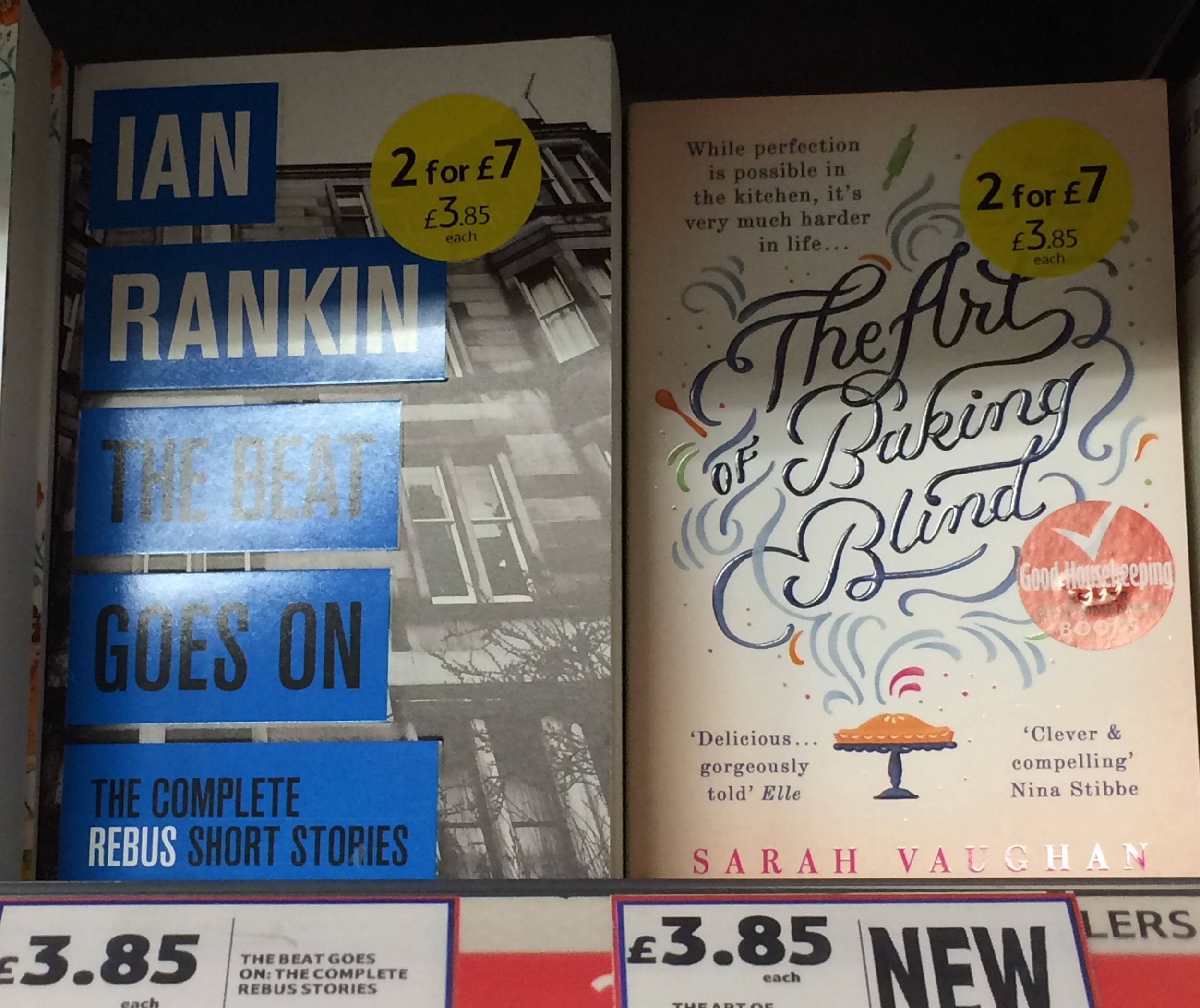
In the month since The Art of Baking Blind came out in paperback, I may have put this photo on social media more than once. Not just because I'm proud of that WH Smith chart position but because it makes me want to laugh out loud.
This is probably the only chance I'll get to snuggle up to Ross Poldark (Demelza's just out of the picture, to the far left; I've rather pointedly edited her out.) I've also been found nudging Marian Keyes and Nick Hornby in Waterstones:

And squeezed next to one of my literary heroes, Sarah Waters:
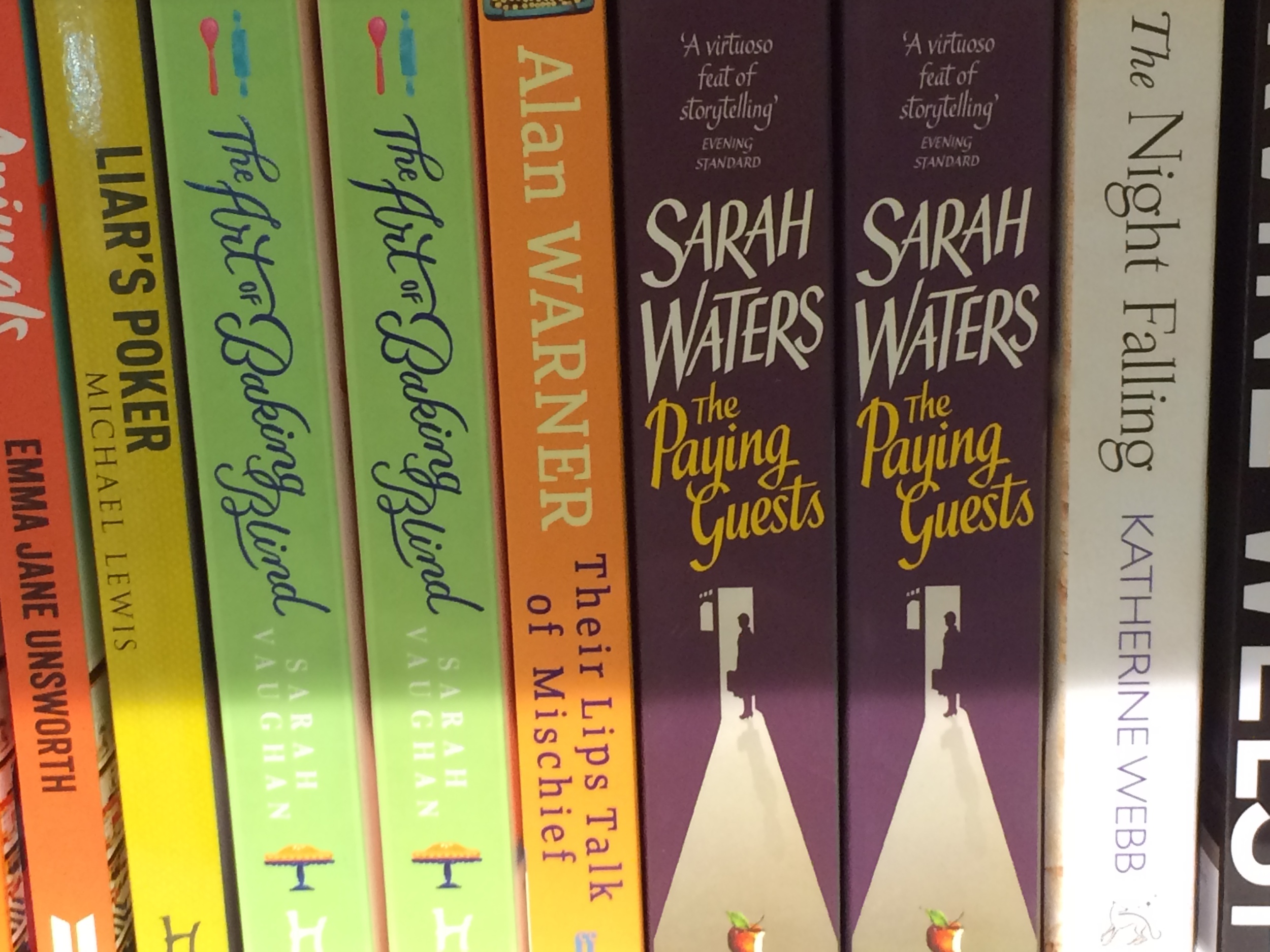
If it seems arrogant or self-indulgent posting these shots, then I do so knowing that my position jostling them is likely to be short-lived. A month after publication, and my novel is no longer at the front of my local Waterstone's - although it is proudly displayed in my local Waitrose, Tesco, Asda and Morrison's (and seemingly out of stock on amazon). And so, as I embark on my third book, I am drawing on these photos to write harder, faster, brighter. Here they are: proof that I once did it; that I might - perhaps - do it again. My avocado spine is aligned with other authors. Proper authors that people have heard of. Look, I tell myself: it's really me.
When I wobble - as I know I will because self-doubt seems intrinsic to writing and to my psyche - I will also remember the gorgeous reviews I've received, and the blog posts written prior to publication day. I've collated my blog posts, partly to remind myself of the flurry of activity; and partly because I want to preserve the optimism and excitement of writing my first novel in some way.
There was a debut author spotlight interview for Shaz's Book Boudoir, here, and a Q and A for the Reads & Recipes blog, here. I wrote about my experience of being an author for Off the Shelf Books, here; and a feature about why we bake for reviewer Chicklit Chloe here.
For Good Housekeeping magazine, I blogged on the different types of baker, here, and for women's fiction website novelicious, I wrote a literary love letter to Kate Atkinson, click here. I have also written for novelicious about my book deal moment and my top writing tips, as well as being interviewed, here. I wrote about the allure of baking and offered a carrot cake recipe. Finally, I shared a recipe for gingerbread men on Alba in Bookland's blog, here.
For now, this flurry of publicity is over as I wait for the copy edits of my second novel, That Summer at Skylark Farm, and start on my third. The editor who bought both books has been headhunted, so I'm writing without a contract: crafting something with which to surprise, and hopefully delight, my publishers. If the prospect is exciting, it's also daunting. But I have two books written, now; and these photographs to buoy, chivvy and inspire me. There I am; nestling up to Poldark. Yes, it's really me.